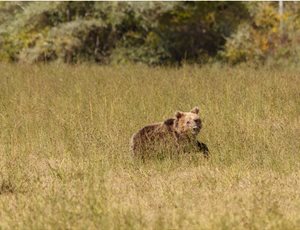
ARCTUROS research based on 22 years of data shows that an increase in bears in Greece does not mean more damage
A new scientific study by ARCTUROS, based on 22 years of official compensation claim data (1999-2020) from the Hellenic Agricultural Insurance Organisation (ELGA), helps clarify the public debate surrounding the brown bear in Greece and addresses a widespread myth: that the recovery of the species inevitably leads to increased damage to human activities. The data show the opposite.
The study analysed 7,067 compensation claims submitted to ELGA for damage caused by brown bears across the country, amounting to approximately €4.1 million. Most damage concerned livestock farming (59.4%), followed by apiculture (23%) and agricultural production (17.6%).
Although the brown bear population in Greece is recovering and expanding geographically, overall damage has not followed a similar upward trend. After an initial increase up to 2009, compensation claims declined and, from 2012 onwards, have remained stable, at levels comparable to those recorded as early as 1999.
In summary, the key findings of the study show that:
- overall damage caused by brown bears did not increase alongside population recovery;
- since 2012, damage levels have remained stable over time;
- the widespread public perception of a generalised increase in human–bear conflicts is not supported by scientific evidence.
Particularly important are the findings relating to where and how damage occurs. The study shows that damage is not evenly distributed across space, but instead displays clear spatial variation.
Specifically:
- In areas where bears have been present for decades and preventive measures have been in place for many years, damage levels are stable or declining.
- Increasing trends are observed mainly in areas:
- where bears have returned relatively recently,
- where local communities have limited experience in managing coexistence,
- and where the systematic application of preventive measures is lacking.
Areas with increased damage differ by activity: in agriculture and apiculture, damage is recorded mainly along the edges of the species’ core distribution, while in livestock farming, damage occurs primarily within established bear range areas.
At the same time, the study identifies clear seasonal patterns, making conflicts predictable. Damage to livestock and agriculture increases mainly towards the end of summer and in autumn, peaking in September, while damage to apiculture is most frequent in spring and early summer, with a peak in June. This predictability shows that conflicts can be reduced if timely and targeted preventive measures are implemented.
Overall, the findings of the study send a clear message: human–bear coexistence is possible and is already taking place in Greece. Scientific evidence demonstrates that:
- protecting brown bears does not result in increased damage;
- prevention is more effective than compensation;
- timely information and support for local communities-particularly in areas where bears are reappearing-are of crucial importance.
The study, Revisiting the Link Between Population Recovery and Human–Wildlife Conflicts: Insights from Brown Bear Compensation Claims in Greece, was published in the international scientific journal Animal Conservation. The authors are Dr Alexandros Karamanlidis, General Director of ARCTUROS, Zoi Skalkou, biologist, and research collaborators Miguel de Gabriel Hernando and Carlos Bautista.
According to the most recent national population estimate carried out by ARCTUROS for the Greek authorities in 2025, approximately 900 brown bears are currently estimated to live in Greece, compared to 450–500 individuals in the previous estimate conducted in 2019.
RECENT ARTICLES
Unplanned Renewable Energy development threatens bears and biodiversity in Greece
Read more
MY FAVORITE HERO… THE WOLF! Environmental Education Programme about the Wolf in Parnitha and Greece
Read more